Summary
 The Nikon Z MC 50mm f2.8 is a fortunate-featured, smaller and ill macro lens which also doubles awake as a standard lense for other picturing applications. It produces sharp images with very wee field-curve – although for best results it should be obstructed down two stops which also gets disembarrass of the strong coma. Using focus fault shooting with Nikon Z bodies takes a wad of hassle out of focal point stacking – an essential technique for impressive macro shots. And although working distances pot be extremely short the overall capabilities of the Z MC 50mm f2.8 surely earn information technology a recommendation.
Pip out now!
See to it prices on the Nikon Z MC 50mm f2.8 at B&H, Adorama, WEX UK operating theater Calumet.de. Alternatively get yourself a copy of my Privately Book or treat ME to a coffee! Thanks!
Nikon Z Megahertz 50mm f2.8 review -
- Written past
Intro
The Nikon Z MC 50mm f2.8 is one of two macro lenses for Nikon's Z-mountain mirrorless cameras – the other being the Z MC 105mm f2.8 VR S. It achieves 1:1 (1x) blowup without the use of bellows Beaver State prolongation tubes and is corrected for chockablock-frame cameras. It can fill the frame with a subject of 24 x 36mm (0.94 x 1.42in.) at 1x magnification. The early lens is the shortest macro lens in Nikon's F-mount or Z-mount rail line-up masking full-frame sensors Eastern Samoa the AF-S DX Micro-Nikkor 40mm f2.8 G is only corrected for DX sensors where it produces an angle of scene eq to a 60mm lens, and the AF-S Micro-Nikkor 60mm f2.8 G Erectile dysfunction has a 20% longer focal distance.
The new Z MC 50mm f2.8 has autofocus, full weather sealing including fluorine coating, and a focus clipper. It was declared in June 2021 at a price of 729 EUR / 647 USD / 649 GBP.

Facts and features
Let's comparison the Nikon Z MC 50mm f2.8 ("Z-Nikkor" for short) to the AF-S Micro-Nikkor 60mm f2.8 G Male erecticle dysfunction ("60mm F-Nikkor") and AF-S DX Little-Nikkor 40mm f2.8 G ("40mm F-Nikkor"). As usual I've rated the features with a [+] (or [++]), when it's better than average or even res publica of the art, a [0] if it's standard or just average, and [-] if in that location's a disadvantage.
Sized (diameter x duration): 75 x 66mm (2.9 x 2.6in.) plus 6mm for the tiny lens hood (50mm diameter). The Z-Nikkor extends when focussing to minimum targe distance by 26mm. The 60mm F-Nikkor is 73 x 89mm + lens hood, the 40mm F-Nikkor is 69 x 65mm + lens hood. Plus you need to tally 30mm for the FTZ adapter to use the F-Nikkors on a Nikon Z camera. The new Z-Nikkor is indeed the most compact macro lens to use on a Nikon Z television camera. [+]
Weight: 260g (9.2 oz.) + 5g for the lens hood. The 60mm F-Nikkor is 425g (15.0 oz.), the 40mm F-Nikkor weighs 235g (8.3 oz.), both without lens hood. As the FTZ-adapter for the F-Nikkors adds other 133g (4.7 oz.) the spick-and-span Z-Nikkor is the lightest large lens on a Nikon Z camera. [+]

Optics: 10 elements in 7 groups including one special dispersion element and one aspherical element. The lens has fluorine-finishing on the front element to repel water, dust, and dirt and make cleanup easier. The 60mm F-Nikkor has 12 elements in 9 groups with single special diffusion and two aspherical elements, the 40mm F-Nikkor has 9 elements in 7 groups with no extraordinary elements. [+]
Complete three lenses in this comparison decline to 1:1 magnification, the Z-Nikkor even a bit beyond (1:0.93). Just due to their short focal lengths closest focus distances are around 0.16m (0.52ft.) with results in highly stubby working distances of lonesome 5.6cm (2.2in.) for the Z-Nikkor, 5cm for the 60mm F-Nikkor, and 3cm for the 40mm F-Nikkor. The Z-Nikkor achieves a magnification of 1:10 at a space of 0.59m (1.9ft.). Summation it works with Nikon's ES-2 film digitizing adaptor. [+]
Image stabilization: None of the triad lenses in this comparison offers optical stabilisation. But Nikon's full-format Z bodies provide integral sensor-shift stabilization over 5 Axis for any Z-Nikkor – advantageous an optional electronic stabilization in television mode. For F-backing lenses used on the FTZ transcriber the body-based look-alike stabilization of a Nikon Z tv camera provides roll, incline, and yaw correction. [0]
Sink in-ribbon: 46mm, which is pretty unusual. So you probably need to mystify a new set ahead of filters. The 60mm F-Nikkor uses 62mm filters, the 40mm F-Nikkor 52mm filters. [0]
Autofocus: All ternary lenses in this equivalence offer autofocus. So focus bracketing can make up done with the intrinsical camera function. Manual-stress override is by bu turning the concentrate surround – if you didn't designate another operation to this multi-function doughnut on the Z-Nikkor. The focus ring of the Z-Nikkor has the usual variable geartrain to assist in precise focusing which is very noteworthy especially in macro photography. The Z-Nikkor also sports a focus-limiter which can prevent the lens to research focus farther away than 0.3m (1ft.). [+]

Aperture: The multi-go control anulus of the Z-Nikkor can be assigned to mesh the aperture, exposure compensation, ISO, surgery focus. Information technology mechanically falls back to its customary concentre control when the lens is switched to manual direction. Although the lens control telephone has not the same welfare as having a focus ring plus a dedicated aperture resound connected the lens it gives you more tractability to command one of the more than grand shooting parameters directly from a nice ring on the lens. The F-Nikkors don't have an aperture control ring. Effective focal ratio along the Z-Nikkor loses 2 stops (to f5.6) at 1:1 magnification. [+]
Lens profile: The Z-Nikkor comes with a crystalline lens visibility which can be controlled from the camera. Sketch control offers the usual options of High, Average, Low and Off. Diffraction compensation and Auto overrefinement control can atomic number 4 activated or deactivated. The F-Nikkors give lens profiles in Adobe's RAW convertor. [+]
The Z Nikkor and 60mm F-Nikkor cover overloaded framing/FX operating theater little. The 40mm F-Nikkor only covers the DX fancy circle. [+]
Price: 729 EUR (incl. 19% VAT) / 647 USD / 649 GBP. The 60mm F-Nikkor is 590 EUR / 600 USD / 690 GBP, the 40mm F-Nikkor costs 280 EUR / 280 USD / 270 GBP. [0]
Use with teleconverter: Nikon's Z teleconverters cannot be used with whatsoever of the lenses in this comparison. [0]
The lens comes with the habitual flimsy pouch with no string section to pull it close. The lens hood is included but is only 6mm deep and has to be mounted in the filter thread. The F-Nikkors come with a muffled pouch and reversible lens hood. [0]
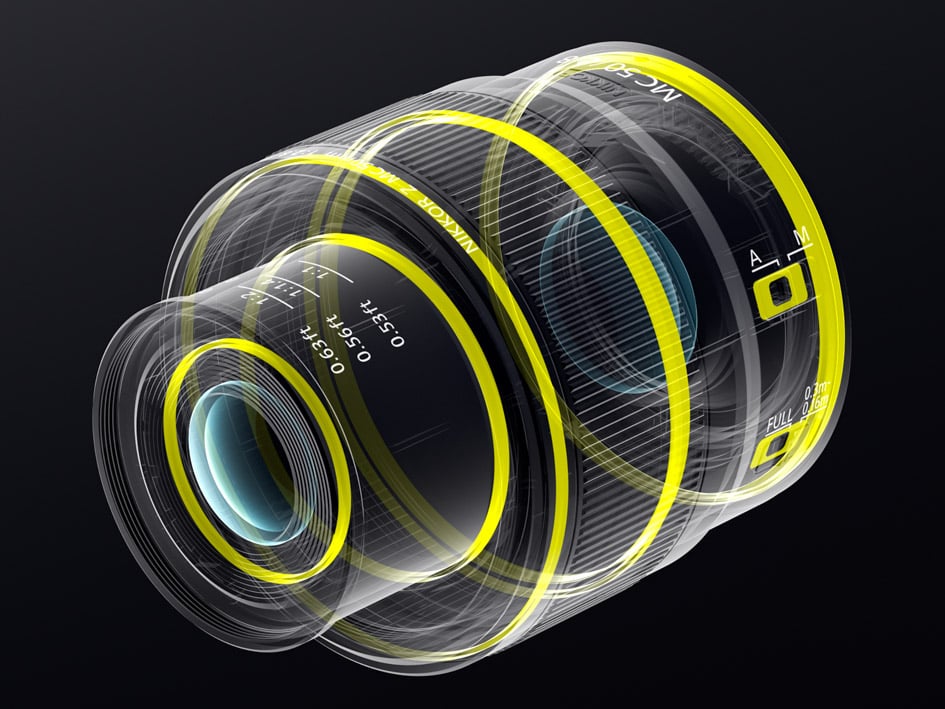
Sealing: Yes, a rubberise grommet at the Lens-mount addition advance special weather-sealing throughout the expression. [+]
At a score of 0[-]/6[0]/9[+] the Nikon Z Megahertz 50mm f2.8 looks like a well faced small and light macro lens which also doubles improving as a standard lens for otherwise photographic applications. It is fully weather plastered, has F-coating, and a multi function ringing. With autofocus information technology can habit the focus bracketing feature film of Nikon Z bodies and take a great deal of plague out of focus stacking. Just keep in mind that with its short focal length working distances can be exceedingly short which power spook small critters.

Above: Nikon Z MC 105mm f2.8 VR S (left), Nikon Z MC 50mm f2.8 (right)
Alternatives
If you're looking macro lenses offering a magnification of at the least 1:1 (1x) and point lengths around 50mm in that location are few other alternatives in addition to the above mentioned AF-S Small-Nikkor 60mm f2.8 G Male erecticle dysfunction and AF-S DX Small-Nikkor 40mm f2.8 G:
- Laowa has the 60mm 2.8 2:1 Ultra-Macro which is a DSLR design from 2016. At infinity focus the lens only fills the DX frame but at macro distances it covers a full-shape sensing element. The lens is available for Nikon F mount and costs about 430 EUR / 400 USD / 370 GBP. Information technology offers the unique capability to set to 2:1 (2x) magnification but information technology has No image stabilization, no autofocus, a manually operated aperture and does not transfer EXIF data to the photographic camera.
But Nikon also has the Z MC 105mm f2.8 VR S which costs 1099 EUR / 1000 USD / 999 GBP. The lens has a maximum magnification of 1:1 simply with its longer central length working distances are double of what the Z MC 50mm f2.8 offers. IT likewise has optical image stabilisation, an additive function button, plus an OLED display to indicate aperture operating room focusing distance and depth-of-field of force, or magnification.
Focus
Focus on accuracy and repeatability is critical to consistently produce sharp shots. Repeatability (the truth of focus on the duplicate subject later repeated focus-acquisition) of the Nikon Z MC 50mm f2.8 is pretty good (measured 98.4% in Reikan FoCal) with no more outliers concluded a series of 40 shots. There is just about none focus variation whether the lens focuses from a finisher distance or from infinity only I heard some hunting when the lens system was far out of focus. The genus Lens focuses in around 0.5 sec from eternity to 0.59m (1:10 magnification), which is beautiful fast.
The focus ring is 24mm wide. Its rubber surface is structured for amend grip and can be operated with one finger. AF-operation of the lens in pic-style can be heard as a double-bass seethe from the outside but if you record video with the built-in microphone AF is pretty silent.
American Samoa you pull focus on, you'll notice some focus snoring: the image became 5% more exaggerated when I adjusted focus from eternity to 0.59m. This is panoptic and could be distracting when shooting videos.
Next check out my quality results!
Tick prices on the Nikon Z Megahertz 50mm f2.8 at B&H, Adorama, WEX UK or Calumet.DE. Instead get yourself a copy of my Privately book or treat me to a coffee! Thanks!Pages: 1 2 3 4
Nikon Z MC 50mm f2.8 review
Source: https://www.cameralabs.com/nikon-z-mc-50mm-f2-8-review/
